Journeys in Liminal Space
‘Folly and Geology’ - Minllyn, Dinas Mawddwy, Mid-Wales
High above Dinas Mawddwy in the
now forested hillside is Minllyn, one of Wales’s oldest slate quarries, having
been mined since 1793 where the prized Narrow Vein outcropped on the surface.
Its Upper Mill was built in 1840 and was the first in Wales to have been
powered by a steam engine. However, in the 1850’s it received a significant
boost when the wealthy Manchester mill-owner Sir Edmund Buckley bought it.
Buckley and his illegitimate son, also called Edmund Buckley, invested heavily
into the production of slate slabs for making billiard tables, fireplaces and
floors as well as toilets and urinals.
Whereas his father had steadily
acquired wealth throughout his life, Buckley junior, who owned the mine from
1864, proceeded to spend his inheritance, enjoying the extravagant lifestyle of
a titled gentleman, improving the Dinas Mawddwy Estate, building a railway to
connect the village to the main Cambrian main line and acquiring large tracts
of land and other slate mines. In 1872 he built a lavish Victorian gothic
mansion at Dinas Mawddwy called ‘Y Plas’. He constructed the Buckley Arms Hotel
in 1873, which was one of the first buildings in Wales to be built of concrete.
The folly of this over-spending
resulted in him going spectacularly bust. In 1876 Buckley junior was declared
bankrupt with debts of more than £60 million in today’s money - an almost
unbelievable amount in the 1870s! It proved to be a death-knell to the Mine.
The Narrow Vein that runs west
to east across Mid-Wales peters out at Dinas Mawddwy. Here the miners had to
chase the Vein across a series of major fault lines. Despite the Buckley’s huge
investment, the geology meant that once they had exploited all the available
slate, the future of the Mine was doomed. Minllyn limped on until its
closure in 1925, but the later workings focussed more on open pits nearer the
large Lower Mill.
An example of the extremely thin pillars found in Minllyn. The passage to the left
is the main transport tunnel along which slabs were taken out from the Mine.
The passage to the right leads into another enormous chamber. The supporting
wall between the 2 passages is much thinner than you might expect.
‘The Hole’ - Minllyn, Dinas Mawddwy, Mid-Wales
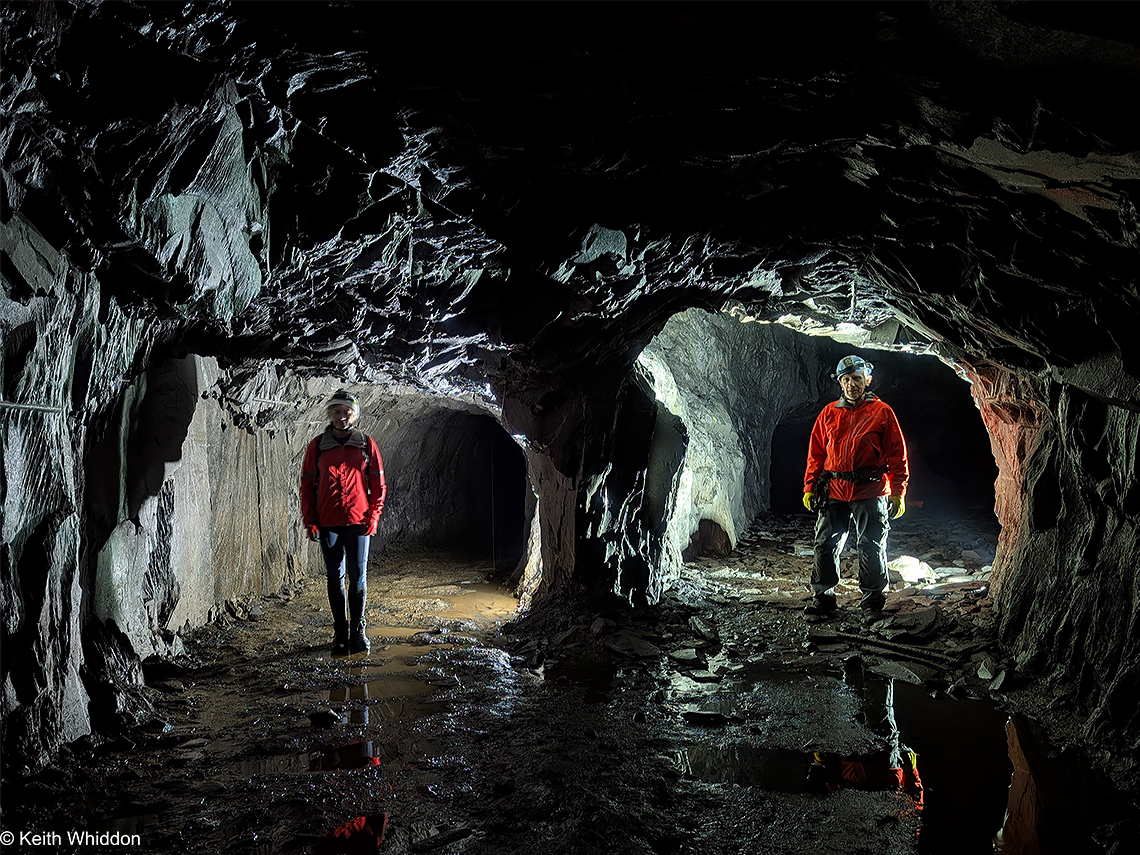
Where the slate vein was located, the miners excavated chambers so bold that only wafer-thin pillars were left to hold up the mountain above. This is illustrated in the photograph where a hole through a supporting pillar shows just how little rock remains.
‘The Winch’ - Minllyn, Dinas Mawddwy, Mid-Wales
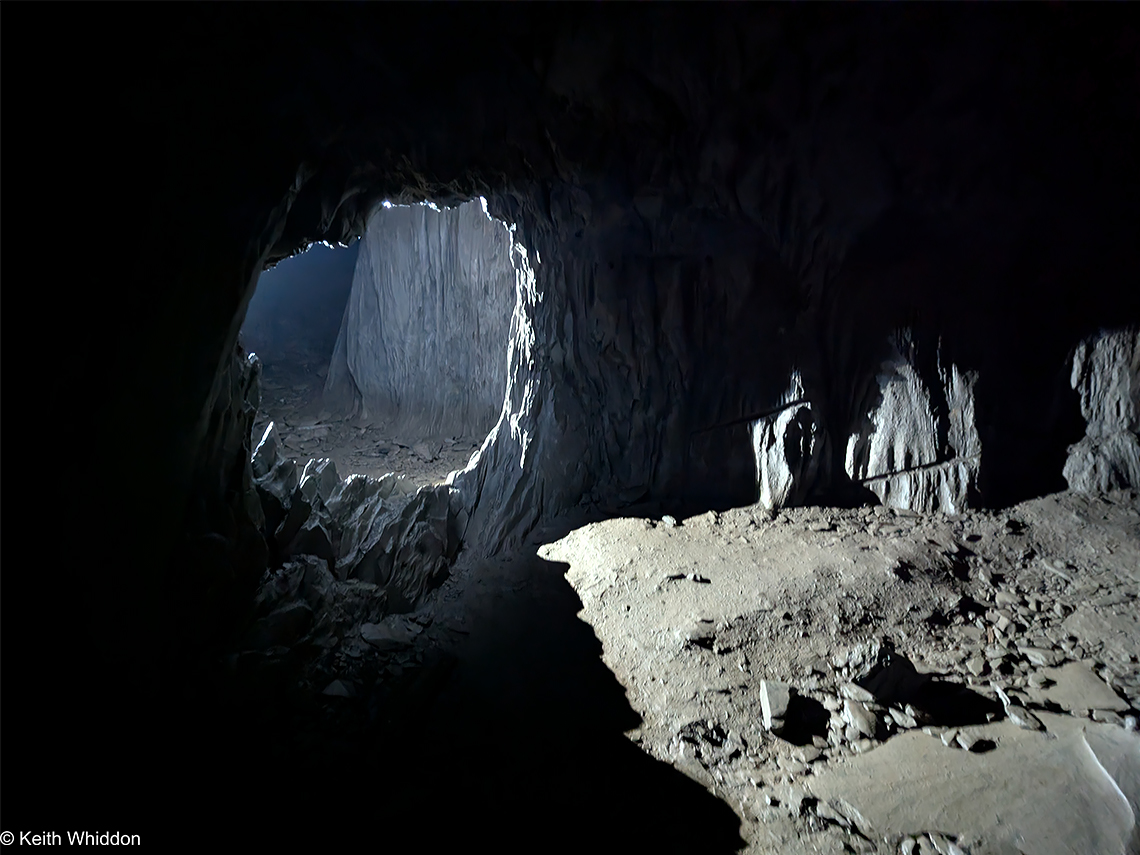
Of the numerous artefacts to be found in the Mine, this example of a mid-19th century hand-winch is probably the finest. Once used to drag huge slabs across the chamber to lift onto a tramway wagon, this winch has now toppled onto its side. Despite it lying there for more than 175 years, the handle still turns the giant flywheel.
 watch a video of the winch
‘An Optical Illusion’- Minllyn, Dinas Mawddwy, Mid-Wales
The main tunnel leading into the Mine, known as an adit. The rail track that was used to carry slate from the mine has long since gone and the adit is now prone to flooding. The ‘tide-mark’ on the walls shows how deep the water can sometimes be. It was waist deep on the day the main photograph was taken and the reflection of the tunnel roof on the water creates an optical illusion.

‘The Main Chamber’ - Minllyn, Dinas Mawddwy, Mid-Wales
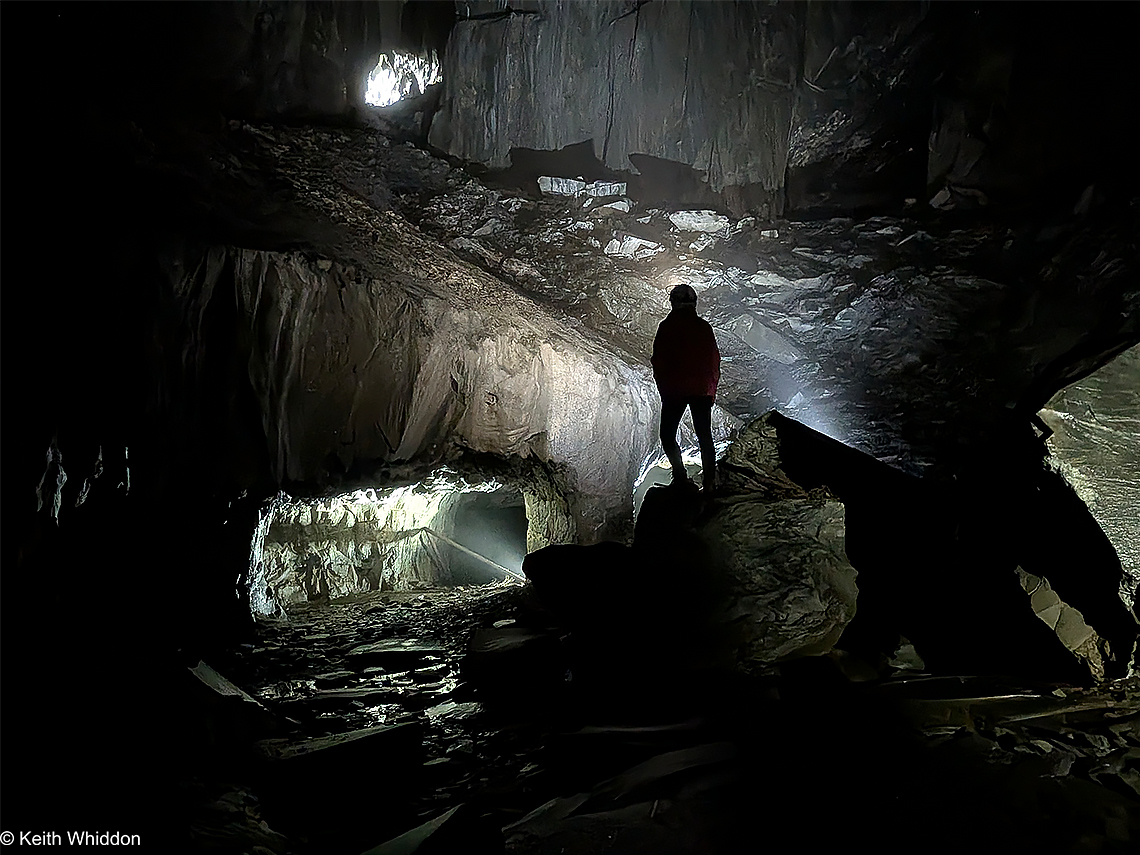
With Buckley’s money, massive underground chambers were opened up in the 1850’s. In one of these chambers a steam-powered crane lifted huge slabs from a deep pit. The coal exhaust fumes were taken from the boiler in an earthenware pipeline, up and out of the Mine through a vertical air shaft to the surface. In the top left of this photograph, daylight may be seen streaming down this air shaft.
‘Cwm Odin’ – Corris, Mid-Wales
In Norse mythology
whosoever drinks the ‘Mead of Poetry’ becomes a scholar able to 'recite any
information and solve any question' (like some Viking AI system). Legend has it
that Odin forced the giant Baugi to dig a hole through the mountain in which
the Mead was kept. Odin then transformed himself into a snake and slithered
into the mountain to take the Mead.
Cwm Odin Mine, as it was
once known, worked the prized Narrow Vein of slate and like Minllyn Mine, it
mainly extracted slabs for billiard tables. It started in 1874 but almost
immediately ran into trouble, its whole story being one of closure and
re-opening, until it closed for good in the 1950’s.
It started life with deep,
vertical pits, but later tunnels were dug into the mountain, creating vast
underground chambers on 4 main levels. The extracted slate slabs were lowered
down very steep inclines to the mill. These inclines provide the only access to
the Mine. Online you’ll read today's explorers describing the ‘heart-attack
inducing climb up’.
While we may not have found
the fabled Mead in the Mine, we did find treasure in the form of ‘caverns
measureless to man’, red and ochre waterfalls, a blue lake and the awe that
comes from being in a place known only to a few. Odin may have been the god of
war and death, but he smiled on us. Oh, and now it appears that we can 'recite
any information and solve any question' - about slate mines!

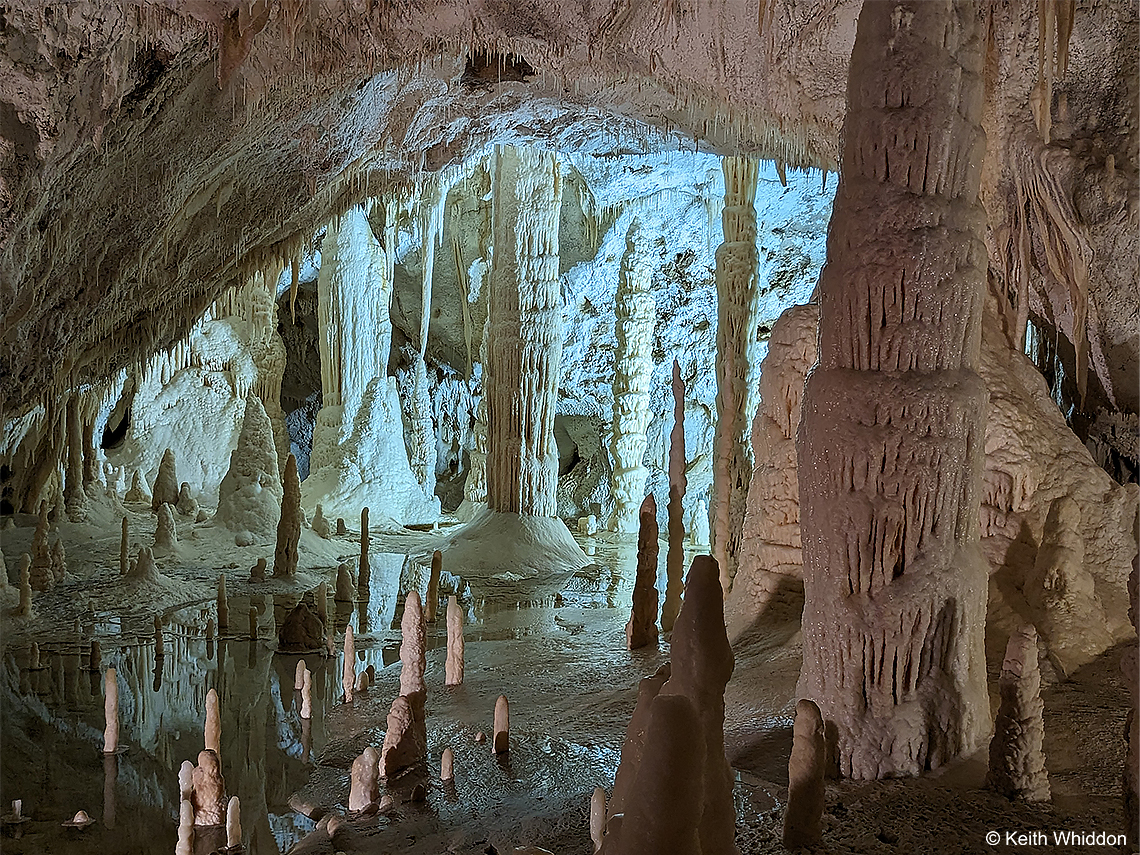
‘Grotte di Frasassi/The Frasassi Caves’, Marche, Italy
In 1971, Rolando Silvestri
of the Marche Speleological Group from Ancona discovered a narrow vertical
entrance on a mountain top with a strong current of air. He entered a narrow
passage and from here slipped in the direction of the edge of a void. He threw
a stone into the chamber below and calculated that it was over 100 metres deep. In
fact this chamber is big enough to hold the entire Duomo of Milan.
Imagine Rolando's
emotions as he descended into this wonderland of cave formations for the first
time! Frasassi is one of the world's most decorated caves and is jaw-dropping
in terms of scale and beauty. Within 10 years, more than
30 kilometres of passages were discovered and the cave was opened to the
public.
My first visit as a tourist
to the Frasassi Caves left me wanting more. I booked onto the 'Speleo Percorso
Rosso' (the Red Cave Route), which is the most adventurous trip offered by the
cave operators, running only a few times through the year. This route requires
full caving suit, gloves (to protect the formations - not yourself), harness,
cows-tails (a pair of climbing carabiners used to clip yourself onto a safety
line), helmet, light and wellies. The 3 hour route begins in the 'Hall of
Infinity', at the end of the tourist trail.
Right at the start is a 30
metre deep chasm called 'The Falconara Well', negotiated by clipping onto a
safety line and traversing around the void on a tiny and very slippery calcite
ledge. Then follows low crawls, including a very low 30 metre crawl known as
the 'Catacombs', vertical climbs and more traverses around false-floors and
vertical pits. It was breath-taking crawling and climbing over these beautiful
cave formations.
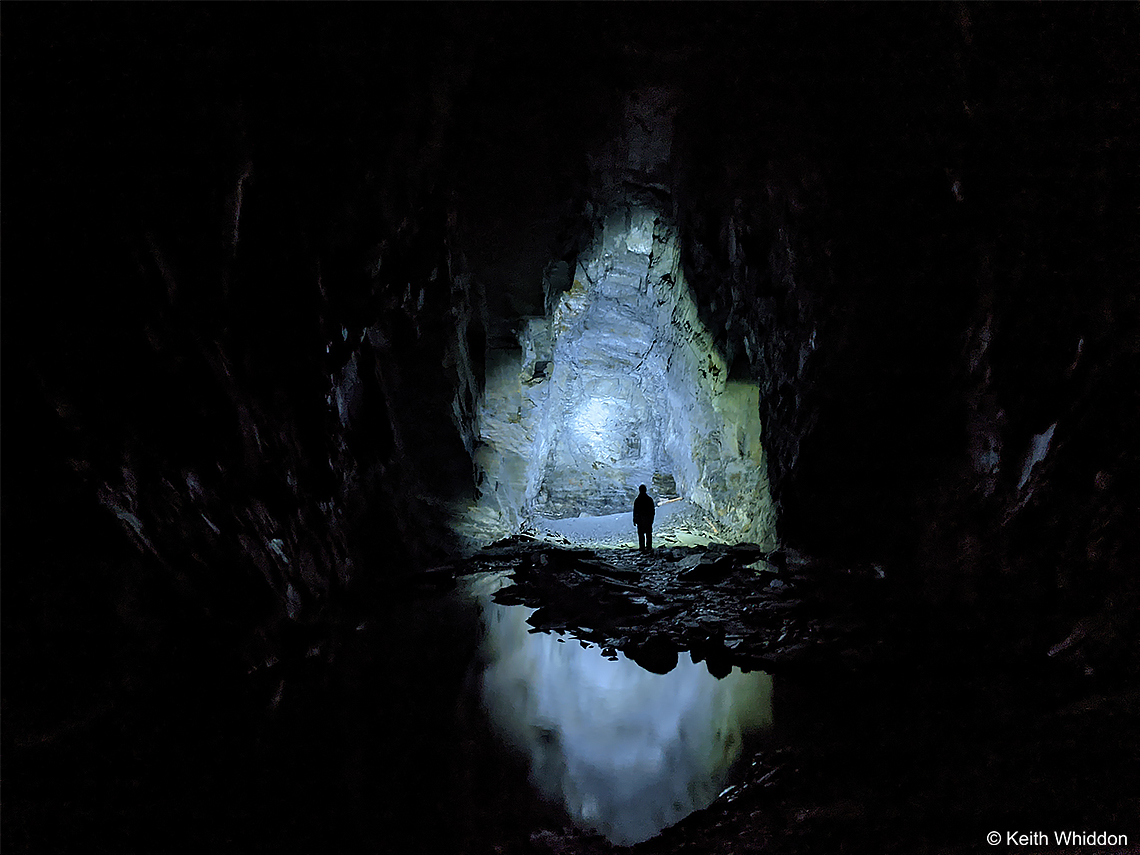
‘The Chamber of Reflections’, Rhiwbach, Ffestiniog, North Wales
Many of us live in houses with old slate roofs yet never stop to consider the hardship and squalor miners went through to hew it from the Welsh mountains. At nearly 500 metres above sea level, Rhiwbach Quarry was one of the most remote in North Wales and was frequently cut off for long periods. As a result, the 70 workers established a primitive village in the 1860s, featuring a shop, school, family accommodation and single men’s barracks. Several children were born and grew up in this village. Commercial operation began here around 1812, and the Quarry finally closed in 1952. Much of the slate was perilously won from deep underground chambers like the one in this photograph.
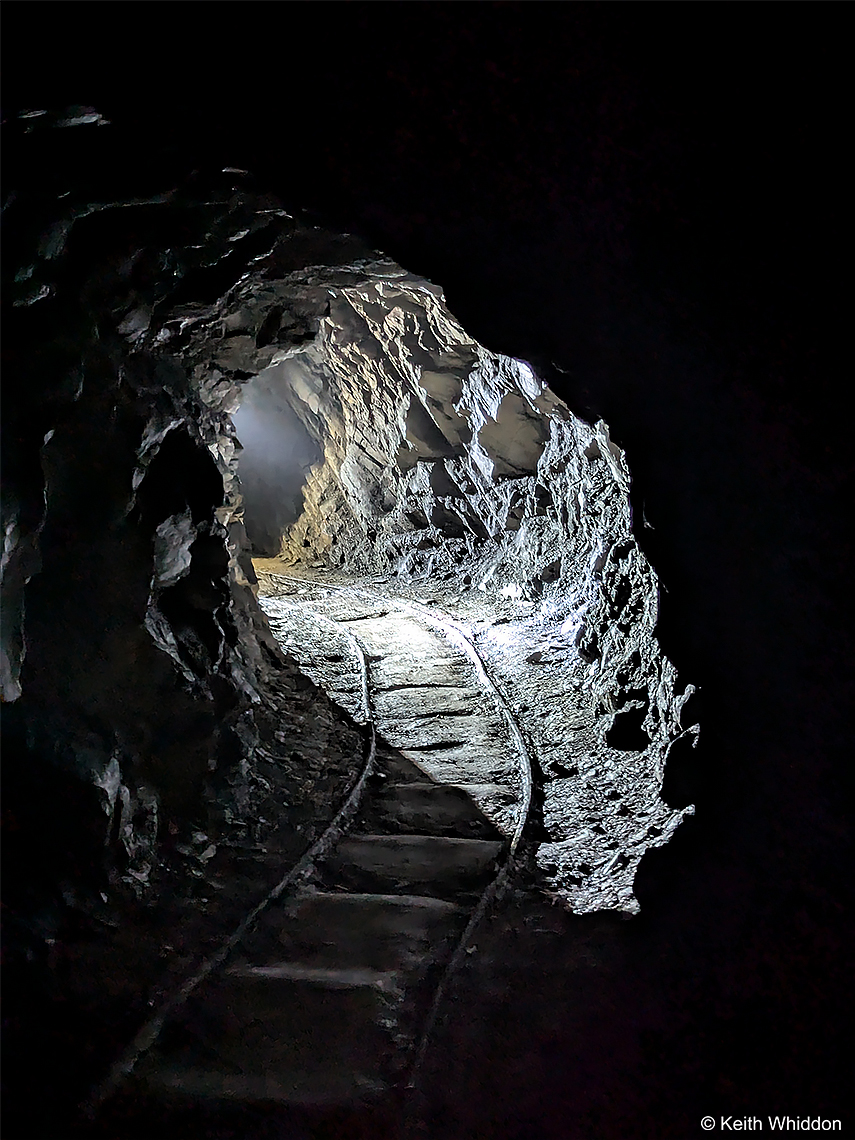
‘Light at the End of the Tunnel’, Ffestiniog, North Wales
This enormous slate mine has well-known and much-loved highlights spread out along its 2.5 kilometres width and length and 300 metres depth. In the further outreaches lie passages virtually undisturbed for more than 100 years. Here the 19th century track has been left just as it was when the last wagon used it.
‘The Klondike Mine Scandal’ – Trefriw, North Wales
Geirionydd Mill, as it was originally known, was constructed in
1900 by the Welsh Crown Spelter Company to process blende, used to
make zinc for spelter. The ore came from the Pandora Mine some 2 miles
away and linked by a tramway and an aerial ropeway that entered the top of the Mill.
It was an ambitious state of the art undertaking, the largest of its kind in
Wales. However, Pandora didn’t prove profitable and by 1911 both Mine and Mill
had closed down.
The derelict Mill was purchased by a Joseph Aspinall in 1918.
Aspinall published an article in the Mining Journal declaring that his company
had discovered very rich deposits of silver and how his Mill had the modern
machinery necessary to process it. He paid for rich investors to travel from
London to view the undertaking for themselves.
However, Aspinall had dressed up the insides of an old exploratory
Mine entrance next to the Mill, by sticking tons of lead concentrate imported
from Cornwall to its walls. Apparently the tunnel ‘glistened like a jewellers
shop!’.
This scam was however revealed to Scotland Yard by the owner of
the nearby Parc Mine and Aspinall was sentenced to 2 years in prison for having
deceptively obtained more than 10 million pounds in today’s money. The scandal
caught the public’s attention and the Mill and old Mine have since become known
as ‘Klondike’ after the famous Canadian Yukon ‘Klondike Gold Rush’.
Even today the walls of ‘Klondike Mine’ have a strange look to
them, as in this photograph.
 TOP
TOP
© Keith Whiddon 2023 - 26